
Saturday, February 15, 2014
"Perfection"
Sometimes in order to be "perfect", we need to be imperfect. In order to create change, we need to take our own initiatives, and act out against the "norms" that society has bestowed upon us. Creating imperfection, or chaos, forces the dominant to hear what the oppress have to say, as well as point out the society’s distorted point of view of perfection. Change can only occur when our society, as a whole, accepts the fact that nothing is perfect. If society accepts this notion, we can then begin a new day.

Friday, February 14, 2014
Excerpt from reflection on Pike's U.S. & Latin American Chapter 1
"This leads
to the idea that Pike explains on page 6 when he says, “Men, as they tend to
perceive the situation, are the creators of civilization. Men, as they tend to
perceive the situation, are the creators of civilization and the architects of
progress, whereas “women are the manifestations of nature. The implication is
that men develop culture in order to understand and control the natural world,
while women, being the embodiment of the forces of nature, must be brought
under the civilizing control of men”. It makes me wonder how twisted the image
of nature is. That to some degree nature is encapsulated to connect with women
but subordinately be controlled by men. In totality men have created culture,
build civilizations, and deconstructed nature, and thus given nature its name.
So if women were to be the “symbol” of nature they are also controlled, and so
are the views towards Latinas (and other women in the world)." - Melisa Garcia
Wednesday, February 12, 2014
Tacit Acceptance
Tonight's class was really clarifying and thought provoking. I'm coming to a much greater appreciation of the significance of examining the rhetoric we encounter and utilize. I found myself really working over the interrelationships of the concepts of gender roles, racial stereotypes, and ecological relationships in this week's readings and film. It seems like all three of these important facets of life are rarely something we question or consider the genesis of. Instead we largely accept things the way they are due to cultural and institutional influence, through routines and implied normality, and through the way we understand nature. Tonight's class and this week's readings have really culminated in an "Aha!" moment for me. I hadn't really wrapped my head around the importance and significance of rhetoric regarding ecology, until today when it hit me that the interrelated and overlapping aspects of society that go on without being challenged are largely tacitly accepted due to an engrained rhetoric and sense of normalcy around prevailing ways of thought. To change our own rhetoric and the way we engage with others, is by its very nature the first step in challenging aspects of our world that could stand to be more closely reflected upon.
That being said, to round out this blog post, we are supposed to post a picture of ourselves. Here is one of me engaging in one of my favorite activities (hiking), meanwhile not tacitly accepting the routinely engrained belief that trees are not food.
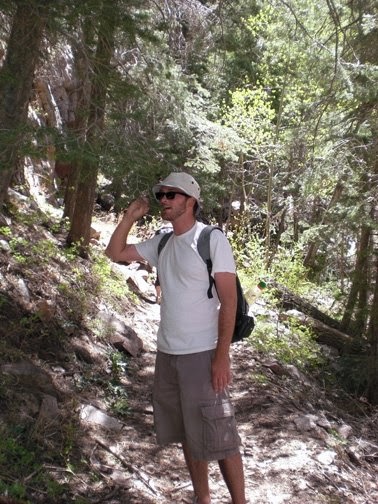
That being said, to round out this blog post, we are supposed to post a picture of ourselves. Here is one of me engaging in one of my favorite activities (hiking), meanwhile not tacitly accepting the routinely engrained belief that trees are not food.
Abiquiu
Abiquiu

Ribbon streams carve
red
soil, winter dusts
tender souls
like shadows flowing.
Friday, January 31, 2014
Bienvenidos!
Muchisimas gracias!
And welcome to our class Chicano Ecology Blog. Looking foward to exploring the stories, environmental rhetorics, and writing about the Southwest and Latin America.
Que vaya bien! Dr. Michelle Kells

Required Texts: Required Films: (Available at Zimmerman Library
Reserve Desk) Learning Outcomes:
And welcome to our class Chicano Ecology Blog. Looking foward to exploring the stories, environmental rhetorics, and writing about the Southwest and Latin America.
Que vaya bien! Dr. Michelle Kells
Dr. Michelle Hall Kells
University of New Mexico
Spring 2014
ENGL 440/540 Latin American Studies Program
Chicano/Latin American Ecology and Rhetoric of Environmental Justice
“As the stones from millions of years reckon, man and
machine are no more than
a shadow of a mote of dust” -Leslie Marmon Silko The Turquoise Ledge (315).
This course will explore
Chicano/Latin American Ecology and environmental writing through the critical
lens of rhetorical theory. We will examine diverse textual
representations of the environment (constructions of Greater Mexico, the US-Mexico border, and
Latin America) as exigences for social action.
Half of the course material will focus on Latin America and the other
half will focus on US-Mexico border issues. The purpose of this class is to
create a community of environmental thinkers and to cultivate opportunities for
considering our roles as citizens, activists, scholars (of place). Participation in field exercises and other learning
environments will be integral to this course.
Our reading list will include environmental texts within and beyond the
Southwest region to include Greater Mexico and Latin America ( as places and
rhetorical constructions).
We will examine, apply, and
critique contemporary rhetorical environmental texts as well as analyze case
studies in 20th century environmental writing and activism. Each
theoretical system of rhetoric advocates a model of symbolic action and maps
the exercise of influence within a socio-historical context. The study of
environmental rhetoric calls attention to the means by which activists
represent and advance their interests as individual agents and collective
entities on behalf of diverse places and their citizens. Environmental writing
is social action; creative and symbolic; dynamic; context-dependent; intrinsic
to human communication; inherent to all forms of social organization. These
conceptual framing principles (as topoi) will inform our analyses of place,
citizenship, agency, and arguments about the multiple uses of
cultural/environmental resources.
The rich literary and
rhetorical legacy of twentieth century environmental writing will be examined
through diverse textual artifacts (and genres) including public rhetoric, film,
poetry, speeches, essays, letters, creative nonfiction as well legal treatises
and policies. These different genres
tell the stories of collective struggle, achievement, and citizenship that
shape current trends in the Southwest, US-Mexico border, and Latin America in
terms of education, law, socio-economic status, government, private
organizational policies, indigenous communities and political participation
related to the environment and its use. This course will focus on literary and
political texts of the 20th century representing the ecology of
place with special emphasis on the environmental justice movements in relation
to land and water rights, climate refugees, biodiversity depletion, solastagia,
etc. (as these movements evolve into the 21st century).
NOTE: This course has been designed for undergraduate and
graduate students in Rhetorical Studies (Department of English), Latin American
Studies, Chicano Studies, Sustainability Studies, Political Science, and
Sociology. We will focus on the range of arguments (across genres and discourse
communities in public/popular cultures) about the environment and ecological
ethics land/earth literacies) throughout the 20th century—applying a pragmatic
approach to modern rhetorical theory as a critical lens. Final course projects will be adapted to the
specific needs, interests, and genre-practices of the students in my course
with respect to their different disciplines and scholarly goals.
Chicano
Ecology Blog:
Students will post segments of our weekly Reader
Response Reflection Journals to our class blog at:
ü Paul Farmer. Pathologies
of Power: Health, Human Rights, and the New War on the Poor.
ü M. Jimmie Killingsworth and Jacqueline S. Palmer. Eco Speak: Rhetoric and Environmental
Politics in America.
ü Joan Martinez-Alier. The Environmentalism of the Poor: A Study of Ecological Conflicts and
Valuation.
ü Devon G. Peña. Chicano
Culture, Ecology, Politics.
ü Frederick B. Pike. The
United States and Latin America: Myths and Stereotypes of Civilization and
Nature.
ü Thomas A. Skidmore and Peter H. Smith. Modern Latin America.
ü Salt of the
Earth.
ü Milagro
Beanfield Wars.
ü When the
Mountains Tremble: Rigoberta Menchú
Course readings, assignments,
films, field exercises, and class discussions are designed to promote the
following learning outcomes:
·
Engage the
analytical resources of rhetorical studies to current environmental issues;
·
Interrogate
questions related to environmental ethics, public health, as well as bio-diversity
and natural resource depletion;
·
Examine
structural systems of exploitation impacting vulnerable communities and diverse
environmental contexts in the U.S. Southwest and Latin America;
·
Analyze the
rhetorical representation of the complex economic and political relationships
conditioning environmental justice and human rights;
·
Apply and
integrate concepts of rhetorical studies to environmental texts;
·
Guide and
participate in class discussions of course readings;
·
Participate in
field exercises and public rhetoric events;
·
Critically
analyze environmental rhetorics across academic and public cultures;
·
Conduct
observations and generate field notes about diverse environmental sites
(natural and constructed spaces);
·
Connect learning to the environmental rhetorics of
everyday life;
·
Develop an
intellectual project through course assignments around the one of the major
themes of environmental rhetoric;
·
Explore regional
environmental resources and build awareness of local communities;
·
Cultivate
alliances with peers and work collaboratively toward common goals.
Friday, January 24, 2014
Solar in California, Premonition of Boom or Bust?

I recently came across an article that claimed solar growth in Clalifornia was larger last year, than in the last 30 years combined. It seems like an interesting trend, but some point out that might actually be cause for some problems for utility companies that could be passed along to consumers that aren't able to get into solar (the impoverished, renters, and those with bad credit). While solar might seem to be perfect for many of our southern states, it is unfortunate that it might also be cause for creating an energy affordability disparity between those that can afford to take advantage of it and those that will be stuck with higher utility prices. From what I understand, the issue for utility companies boils down to the infrastructure costs and peak energy demand not scaling down along with the decrease in dedicated consumers, which leads to a need to increase the per kilowatt hour prices to maintain the infrastructure necessary to meet peak power demands. So, the more people that switch to solar, the more the price per kilowatt hour will rise for those without, unless solar consumers are stuck with a higher surcharge for being connected to the grid (or go completely off grid and invest in battery banks - which leads to plenty of issues when it comes time to dispose of the batteries). Overall, it seems like (barring advancements in battery technology) we might still have some tough policy decisions that will need to be made on utility pricing in light of potential solar booms. Just something I found interesting enough that I thought might be worth sharing here. It is strange to consider the awkward implications of increased economic disparity potentially becoming linked with this ecologically sound energy resource.
*The above picture is of an "earthship" in Northern New Mexico. Source link.
Subscribe to:
Posts (Atom)